Welcome to the ultimate guide for applying for an EWS (Economically Weaker Section) Certificate through the RTPS Bihar portal in 2026. If you belong to the General Category and want to claim the 10% reservation in government jobs and educational institutions, this certificate is mandatory.
In this guide, we will walk you through the updated 2026 eligibility criteria, the exact documents you need, and the step-by-step process to apply online at serviceonline.bihar.gov.in without getting rejected.
What is an EWS Certificate?
The EWS Certificate is an official document issued by the Government of Bihar to citizens belonging to the General Category (Unreserved Category) who meet specific low-income criteria. It guarantees a 10% quota in state and central government jobs, as well as college admissions.
How to apply for EWS Certificate online vai RTPS Portal?
Here is the step-by-step process to apply for a Bihar EWS certificate online:
Step 1: Gather Your Required Documents
Before starting your application, ensure you have the following necessary documents ready:
- Identity and Address Proof: Aadhaar card, Voter ID card, or PAN card.
- Income Certificate: Note that for married women, the income certificate must be made from their in-laws’ side (sasural), while their identity proof will be tied to their maternal home (maike).
- Land/Property Documents: Documents like your khatiyan or deed (daan patra).
- Additional Documents: Ration card (if available), a self-declaration form (affidavit), and passport-size photographs.
Step 2: Go to the RTPS Portal
Open your web browser and search for “RTPS Bihar” to access the official Right to Public Services portal.
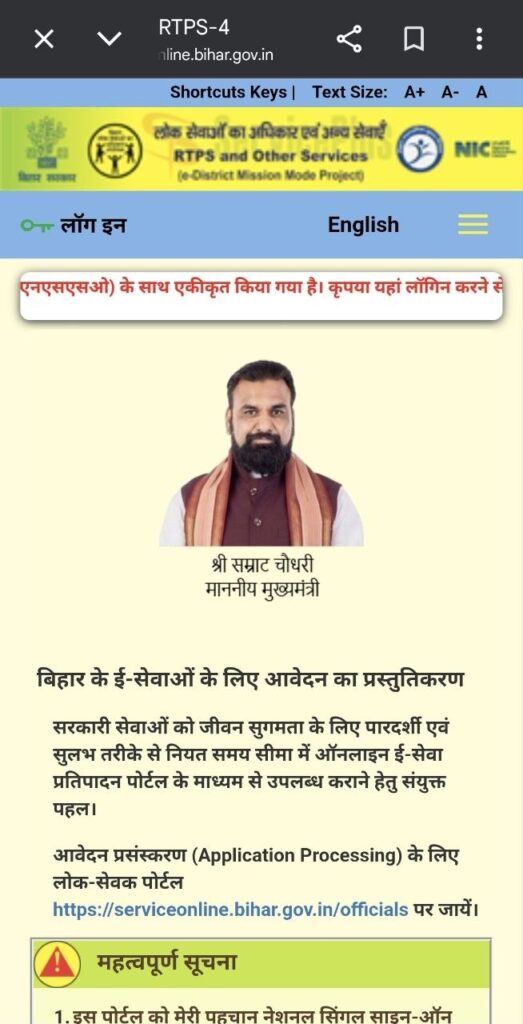
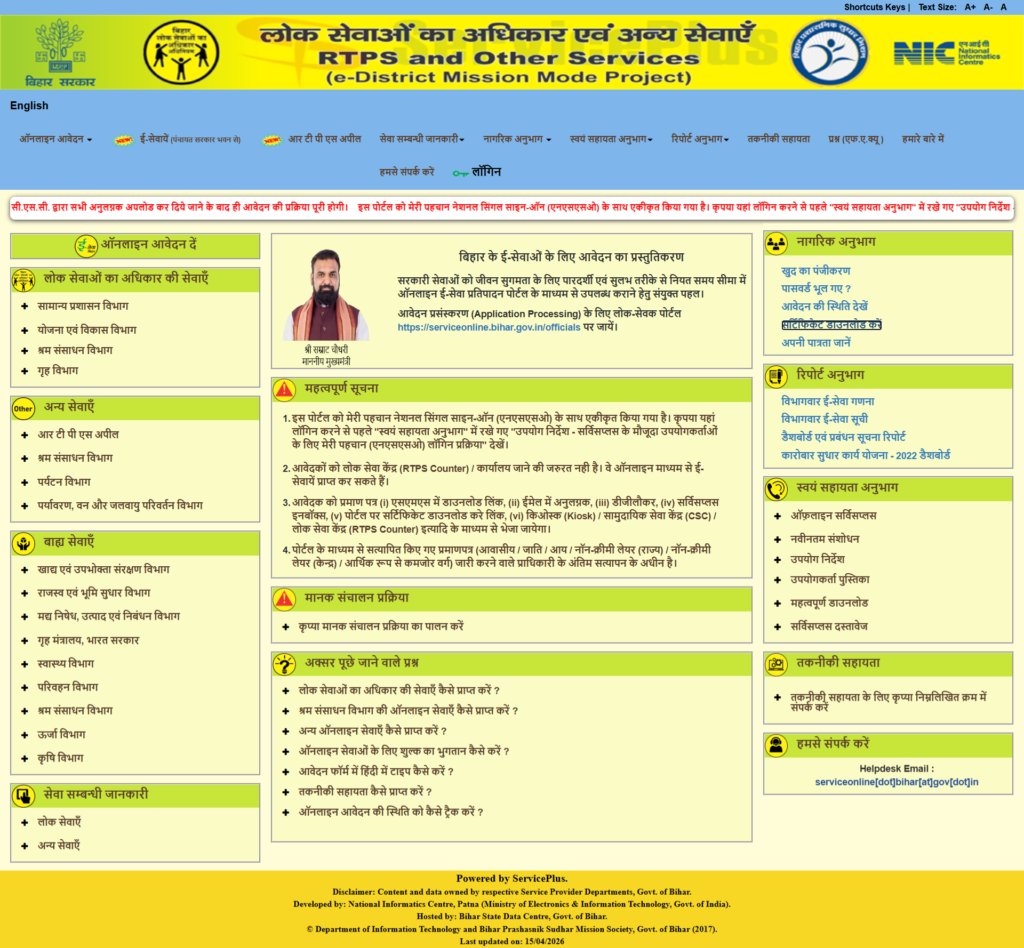
Step 3: Navigate to the EWS Section
Once on the portal, find and click on the option for the General Administration Department (सामान्य प्रशासन विभाग).
Step 4: Select the Certificate Issuance Link
Under this department’s menu, click on the specific link for the “Issue of Income and Asset Certificate for Economically Weaker Section” (आर्थिक रूप से कमजोर वर्ग के लिए आय और संपत्ति प्रमाण पत्र का निर्गमन). You will generally start the process at the Anchal (circle/block) level.
Step 5: Fill and Submit the Form
An application form will open up. Fill in all your details accurately, attach all the relevant documents, and submit the application.
After submission, your application will undergo a strict background verification by local authorities before the certificate is officially issued.
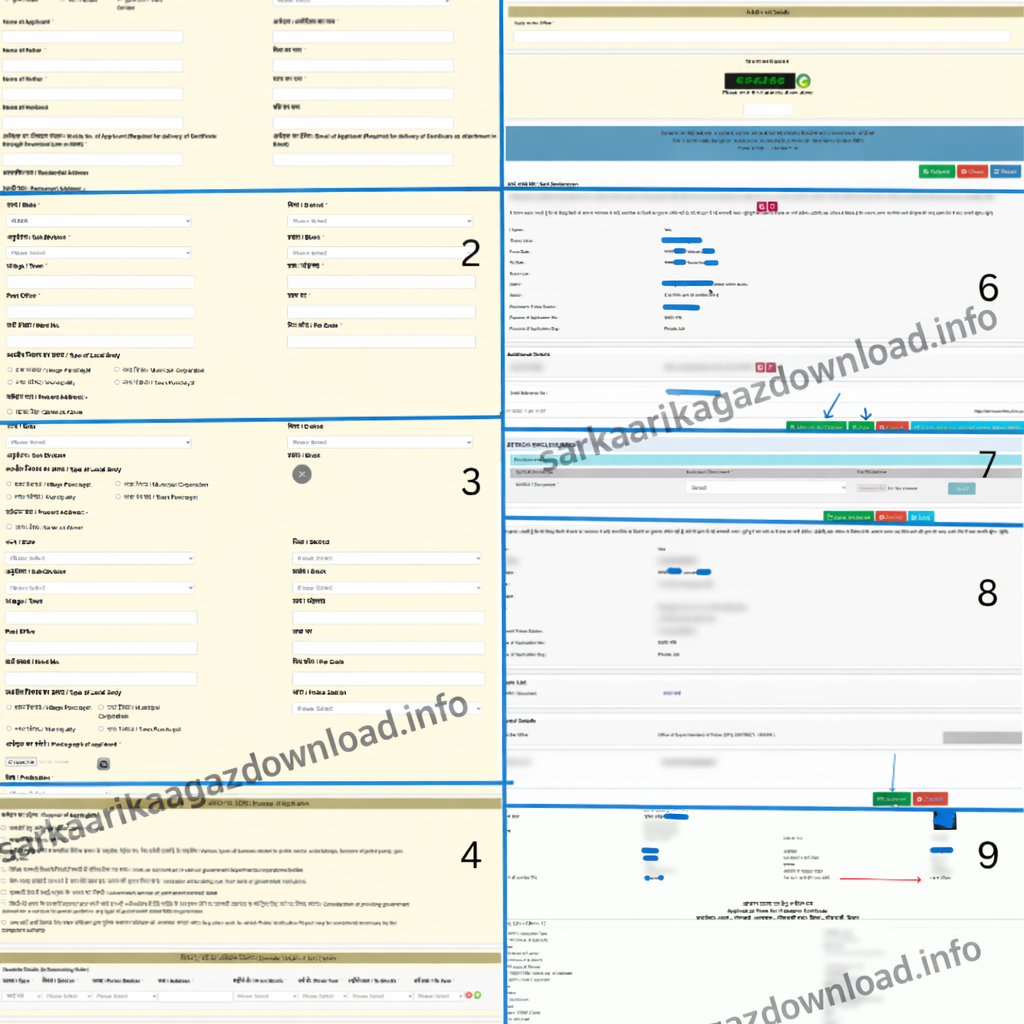
How to check status of your Residence Certificate?
To check your residential certificate status through RTPS Bihar’s online ServicePlus portal:
STEP 1
On the RTPS homepage, go to the right-hand side under the Citizen Section and click on Track Application Status.
STEP 2
A new page will open. Enter your Application Reference Number (from your acknowledgement slip), Application Submission Date, and the Captcha. Then click on the Submit button.
You may see an option asking: “Do you want to view/download the documents of your application (if any)?”
Select Yes or No as per your preference and click Submit again.
After that, your application status will be displayed on the screen.
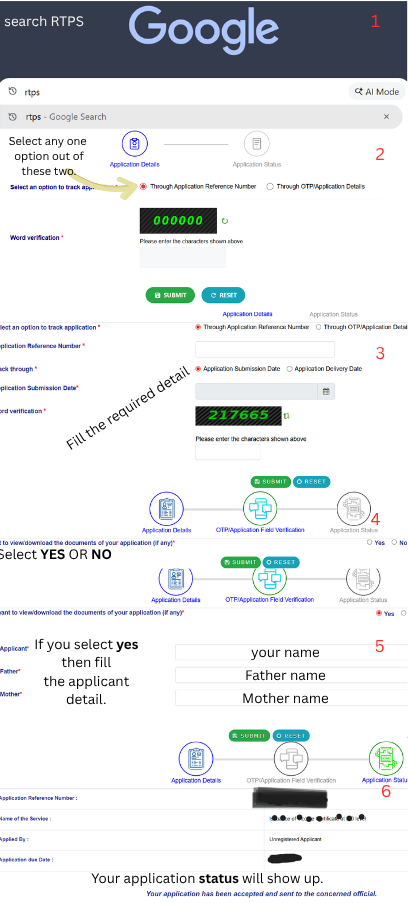
Note: This page is only for demonstration. When you click ‘Submit,’ you will be redirected to the official government website to continue.
Track Application Status
After hitting the submit button one more page will open there it will ask “Do you want to view/download the documents of your application (if any)* YES OR NO “.
If you select yes it will ask applicant name, applicant father and mother name. if you select no it will directly show your status there but you cant download it.
How to Download Your Residence Certificate from RTPS ServicePlus Bihar?
To download you Residence or Domicile Certificate online from RTPS Portal:
STEP- 1
On the RTPS homepage, go to the right-hand side under the Citizen Section and click on “Download Certificate.“
STEP- 2
A new page will open. Enter your Application Reference Number and Applicant Name (in English). Then fill in the captcha and click on the Download button.
If your certificate is ready, it will be downloaded instantly. If not, you may see a message like “Certificate not available due to pending” or it may show that your application has been rejected.
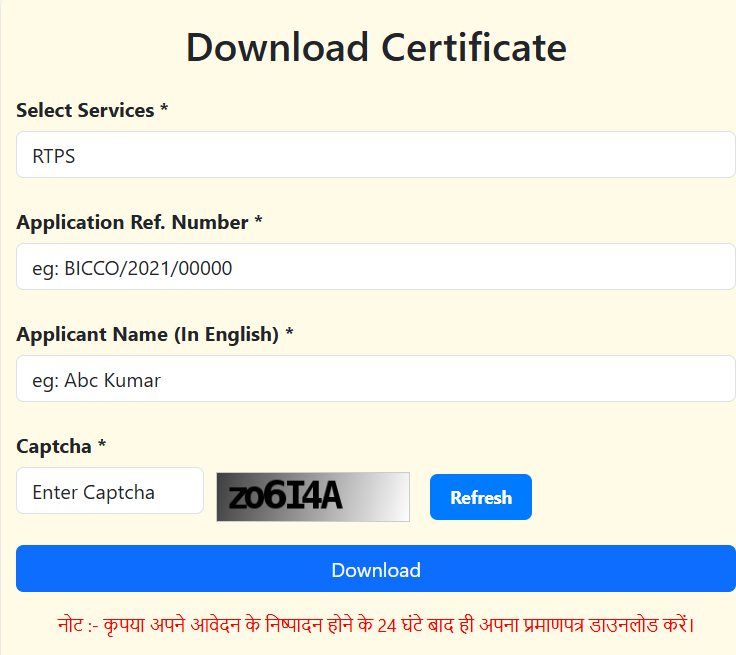
नोट :- कृपया अपने आवेदन के निष्पादन होने के 24 घंटे बाद ही अपना प्रमाणपत्र डाउनलोड करें।
Understanding the New EWS Rules (2026): Everything You Need to Know
How do Bihar’s new EWS guidelines calculate total family income?
Under Bihar’s new EWS (Economically Weaker Section) guidelines, the calculation of total family income has been simplified and strictly defined. Here is how it is calculated:
- Who is included in the “family”: The most significant update is that the income of the applicant’s parents (mother and father) is now completely excluded from the calculation. To determine eligibility, officials will only count the combined income of the husband, wife, and their dependent children.
- What income sources are counted: The calculation is not based solely on regular salary. Instead, it combines earnings from all possible sources, including salary, agricultural land, business profits, and any other income streams.
- The Income Limit: Once all sources of income for the husband, wife, and dependent children are added together, the total annual family income must be strictly less than ₹8 lakhs.
If your defined family’s combined income from all sources remains under this ₹8 lakh threshold, you meet the income eligibility criteria for the EWS certificate.
What are the specific property and land limits for eligibility?
To qualify for the EWS certificate, your accumulated wealth is evaluated alongside your income, and exceeding any one of the following property limits will automatically disqualify you:
- Agricultural Land: Your family must own less than 5 acres of agricultural land. The guidelines specifically emphasize calculating this limit in acres rather than the local bigha unit, as 5 bighas is significantly smaller than 5 acres. Do not let officials disqualify you based on a 5-bigha measurement.
- Residential Flats: Any residential flat owned by the family must be less than 1,000 square feet.
- Urban Residential Plots: If you own a residential plot in a municipality or urban area, it must be less than 100 square yards.
- Rural Residential Plots: If the residential plot is located in a rural area, it must be less than 200 square yards.
If your property exceeds even a single one of these specified limits, you are considered “wealthy” under the guidelines and will automatically fall outside the EWS eligibility criteria, regardless of your annual income.
How can I avoid administrative delays when applying for EWS?
To avoid administrative delays when applying for your EWS certificate, you should proactively prepare according to the Bihar government’s new, standardized guidelines. By understanding the rules, you can prevent officials from misinterpreting your eligibility.
Here are the specific steps you can take to ensure a smooth process:
- Understand the “One State, One Rule” Framework: The Bihar government has released a comprehensive 28-point Q&A guideline that every District Magistrate (DM) and Circle Officer (CO) must follow. This eliminates the old problem of officials making up their own arbitrary rules. Being aware of these guidelines ensures that you cannot be misled by block-level clerks or officers.
- Calculate Your Land in Acres, Not Bighas: A major source of confusion and potential rejection is how agricultural land is measured. The legal threshold is less than 5 acres, but local officials may ask if you have “5 bighas”. Because 5 bighas is much smaller than 5 acres, you must calculate your exact landholding in acres beforehand. If an official tries to count your land in bighas, you can confidently clarify that you are well under the 5-acre limit.
- Ensure Correct Income Calculation: Be prepared to point out that your parents’ income is now completely excluded from the calculation. To avoid delays from officials wrongly inflating your income, make sure your income certificate strictly reflects only the combined earnings of the husband, wife, and dependent children (which must be under ₹8 lakhs).
- Submit Only True and Verifiable Information: The administration has made strict, in-depth verification mandatory before issuing any EWS certificate. To prevent your application from getting stuck during the verification phase, ensure every detail you provide is 100% accurate. Providing false or hidden information will not only delay the process but will lead to a rejection, punitive action, and potentially the loss of any job secured using the certificate.
- Use the Pre-Application Checklist: Before applying, do a final review to ensure you do not exceed any of the property limits (e.g., flats strictly under 1,000 square feet, urban plots under 100 square yards, and rural plots under 200 square yards).
Because the certificate must be renewed every financial year (starting in April), having all your correct measurements and income details ready will help you bypass the usual administrative bottlenecks.
What is the maximum amount of agricultural land allowed?
The maximum amount of agricultural land your family is allowed to own to remain eligible for the EWS certificate is strictly less than 5 acres.
It is crucial to pay attention to the unit of measurement. In Bihar, land is traditionally measured in bighas, which often causes confusion between applicants and local officials. An official might ask if you own 5 bighas of land and mistakenly tell you that you are ineligible.
However, 5 bighas is significantly smaller than 5 acres. You must calculate your exact landholding in acres and ensure officials are using the 5-acre legal limit to evaluate your eligibility, rather than the local bigha measurement.
Are residential plots treated differently in rural and urban areas?
Yes, residential plots are evaluated differently depending on whether they are located in an urban or rural setting. The specific limits under the new guidelines are as follows:
- Urban Areas: If your residential plot is located in an urban area, it must be strictly less than 100 square yards. Owning a plot of 100 square yards or more in an urban setting automatically makes you ineligible to receive the EWS certificate.
- Rural Areas: For residential plots located in rural areas, the limit is higher; the plot must be strictly less than 200 square yards. If your rural plot is 200 square yards or larger, you will be disqualified.
Which local authorities are responsible for issuing the certificate?
The EWS certificate is issued by the local Circle Officer (CO), who is also referred to as the revenue officer. These officers operate at the local block or circle (anchal) level.
In the past, applicants frequently faced administrative delays because different District Magistrates (DMs) and Circle Officers would interpret the rules according to their own arbitrary understanding. Under the new “One State, One Rule” guidelines, all local authorities, including DMs and revenue officers across every district in Bihar, must strictly adhere to the same standardized 28-point framework when evaluating applications and issuing the certificates.
How long is a Bihar EWS certificate valid for?
A Bihar EWS certificate is valid for one financial year. Because the validity is tied to the financial year, the certificate must be renewed or newly applied for every year, starting in April after the previous financial year ends in March.
What benefits does the 10% EWS reservation provide in Bihar?
The 10% EWS (Economically Weaker Section) reservation provides two primary benefits for economically vulnerable candidates from the general category in Bihar:
- Government Jobs: Eligible candidates receive a direct 10% reservation in direct recruitment for government jobs.
- Educational Admissions: The reservation also applies to enrollment in educational institutions, including universities, giving eligible students a 10% quota for admissions.
These benefits are designed specifically for the upliftment of economically weaker individuals within the unreserved (general) category who meet the strict income and property limits.
What does Bihar’s ‘One State, One Rule’ framework mean?
Bihar’s “One State, One Rule” framework is a standardized administrative policy introduced to eliminate confusion, arbitrary interpretations, and delays in the issuance of EWS certificates.
Previously, individual District Magistrates (DMs) and local revenue officers (Circle Officers or COs) across different districts and blocks would interpret EWS eligibility rules according to their own understanding. This lack of uniformity often led to inconsistencies, corruption, and frustrating delays for applicants.
To solve this, the state government has introduced a uniform framework based on a clear set of 28 question-and-answer guidelines. Under the “One State, One Rule” policy, the following changes have been implemented:
- Universal Standardization: Because Bihar is a single state, there is now strictly one set of rules that applies uniformly across all regions.
- Strict Official Compliance: Every authority figure, from local revenue officers to DMs, must use the exact same 28-point guidelines as their standard framework for evaluating applications. Officials in every district—whether in Patna, Gaya, Muzaffarpur, or Bhagalpur—must accept the exact same interpretations of the rules.
- Transparency and Ease: The framework ensures proper coordination between officials and citizens, transforming a previously complex and confusing process into a transparent, citizen-friendly, and hassle-free system.
Ultimately, this framework prevents local clerks and officers from misleading applicants, ensuring that no official can reject an application based on their own fabricated or outdated rules.
Are there specific benefits for Bihar teacher recruitment candidates?
Yes, having an EWS certificate will be highly beneficial for candidates looking to participate in upcoming teacher recruitment in Bihar.
Specifically, the 10% EWS reservation will apply to the upcoming TRE-4 (Teacher Recruitment Exam 4), which is expected to announce vacancies for approximately 46,000 teachers. Additionally, the EWS certificate will be required and beneficial for those applying to the upcoming Assistant Professor recruitments in the state.
By successfully obtaining the EWS certificate under these new, simplified guidelines, eligible candidates ensure they can claim their 10% reservation in these major upcoming hiring drives without facing administrative delays or missing out on the opportunity.
What are the penalties for providing false info?
The Bihar government maintains a zero-tolerance policy towards fraud and the submission of false information in EWS certificate applications.
If you hide facts or provide incorrect details to obtain the certificate, you will face the following severe penalties:
- Punitive Legal Action: Strict laws will be enforced, and you will face direct punitive action for falsifying information or hiding assets.
- Immediate Loss of Employment: If you manage to secure a government job using a fraudulently obtained EWS certificate, your employment will be terminated and your job will be taken away as soon as the discrepancy is discovered.
To prevent fraud, local administrations are now legally mandated to conduct strict, in-depth background verifications before issuing any certificate. Because of these rigorous checks and severe penalties, it is highly advised to only apply for the certificate if you genuinely meet all the income and property requirements.